Breaking down on the road is never part of the plan. But when it happens — whether on the M4, the A4, or a quiet residential street in Slough town centre — how your vehicle gets recovered can be just as important as getting it fixed. Not all breakdowns are equal, and not all recovery methods are suitable for every situation.
That’s where flatbed breakdown recovery comes in. It’s a specialist method that has quietly become the gold standard for safe, damage-free vehicle transportation — and if you’re in Slough or the surrounding Thames Valley area, understanding how it works could save you money, protect your vehicle, and get you back on the road faster.
This blog covers everything you need to know about breakdown recovery in Slough — specifically how flatbed recovery works, when it’s the right choice, what it costs, and how to find the right operator.
The Scale of Roadside Breakdowns in the UK
Before diving into the mechanics of flatbed recovery, it’s worth understanding just how frequently UK drivers find themselves in need of roadside assistance.
According to the RAC, its patrol teams attended over 2.5 million breakdowns in 2023, with battery failures, tyre problems, and engine faults accounting for the majority of callouts. The AA reports a similarly high volume, attending approximately 3.2 million breakdowns annually across the UK.
Slough sits at the intersection of some of the busiest road corridors in the country. The M4 motorway, which cuts directly past the town, is consistently ranked among the top 10 most congested motorways in England by the Department for Transport, with daily vehicle flows regularly exceeding 100,000 on key sections. The A4 Bath Road, which runs through the heart of Slough connecting it to London in the east and Reading in the west, adds a further layer of high-volume traffic risk for drivers.
The result is a town where breakdown incidents are not occasional — they are a daily reality. And for many of those incidents, flatbed recovery is the safest and most appropriate solution.
What Is Flatbed Breakdown Recovery?
Flatbed breakdown recovery — sometimes referred to as flat-deck or rollback recovery — is a method of vehicle transportation in which your car, van, or motorcycle is loaded onto a flat, level platform mounted on a specialist recovery truck, rather than being towed behind it with two wheels still on the ground.
The vehicle is winched or driven up onto the flatbed using a hydraulic tilting mechanism and secured firmly with wheel straps and safety chains before transport. The entire vehicle is lifted clear of the road surface and transported in a static, horizontal position to its destination.
This is fundamentally different from a wheel-lift or tow-bar recovery, where the rear or front wheels remain in contact with the road. In those methods, the vehicle is partially dragged — which is perfectly fine for many standard recovery situations but can cause significant damage or mechanical complications in others.

How the Flatbed Recovery Process Works: Step by Step
Understanding the actual process helps you know what to expect when you call for breakdown recovery in Slough and a flatbed unit is dispatched.
Step 1 — The Callout and ETA
Once you contact your breakdown recovery provider, they assess your location and the nature of the breakdown. In Slough and the surrounding area, well-resourced local operators typically aim for response times of 30 to 60 minutes for non-motorway callouts, though the RAC notes that average UK response times for standard breakdowns sit at around 40 minutes, with motorway incidents often resolved faster due to statutory requirements.
On motorways like the M4, Highways England (now National Highways) requires that any vehicle left stationary on a live carriageway is attended to within 20 minutes under its Traffic Officer Service protocols — a critical safety standard that reputable recovery operators align with.
Step 2 — Scene Assessment and Safety
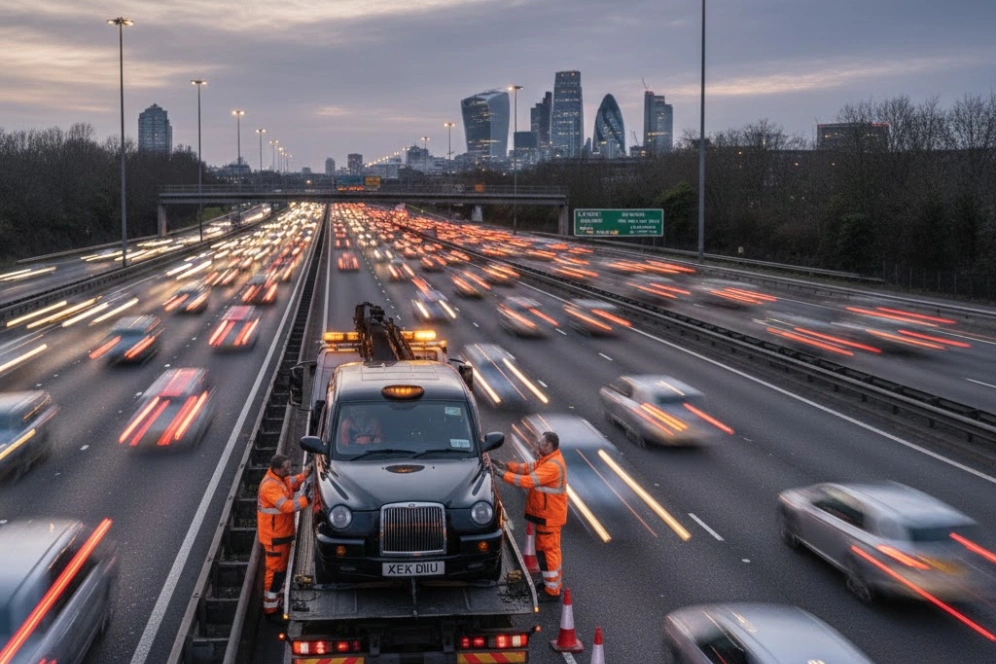
When the recovery technician arrives, their first priority is safety — yours, theirs, and other road users’. On busy roads or motorways, this includes deploying warning triangles, cones, and amber flashing lights. If you’re in a dangerous position such as a live lane or hard shoulder, they will work quickly to secure the scene before beginning any vehicle assessment.
Step 3 — Vehicle Assessment
The technician will carry out a rapid inspection to determine whether a roadside fix is possible or whether full recovery is required. If recovery is needed, they’ll assess your vehicle type, drivetrain configuration (front-wheel-drive, rear-wheel-drive, all-wheel-drive, or 4WD), damage extent, and ground clearance — all of which influence whether a flatbed or alternative recovery method is most appropriate.
Step 4 — Loading onto the Flatbed
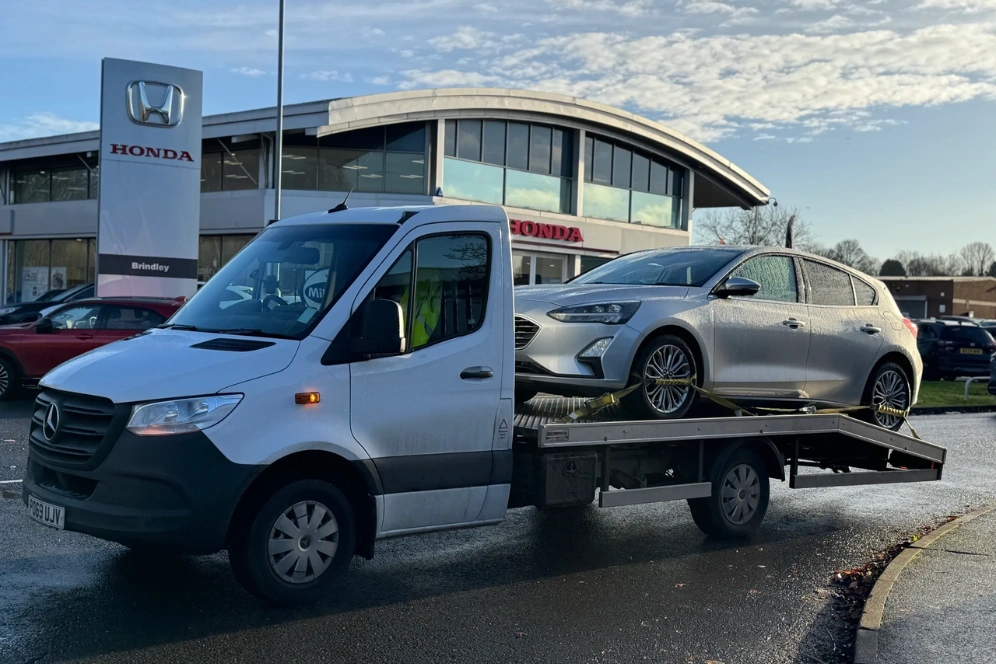
The flatbed platform is hydraulically tilted to create a loading ramp. If the vehicle can be driven — or rolled under its own weight — it may be guided up under controlled conditions. If it cannot move at all, a winch cable is attached to a designated towing point on the vehicle’s chassis (never the bumper or bodywork) and the vehicle is carefully winched up onto the deck.
Once on the platform, the flatbed returns to its horizontal position, and the vehicle is secured with EN 12195-2 compliant lashing straps — the European standard for load securing in road transport.
Step 5 — Transportation and Delivery
The vehicle is then transported to your designated destination — whether that’s a local garage in Slough, a dealership, your home address, or a further destination such as a workshop in London or Reading. Reputable operators offering breakdown recovery service in London will handle cross-boundary transportation without any issues, covering the Slough-to-London corridor efficiently given the M4 and A4 access.
When Do You Actually Need Flatbed Recovery?
This is the question most drivers don’t know the answer to until they’re standing on the roadside — so here’s a clear breakdown.
Your Vehicle Is All-Wheel Drive or 4WD
This is perhaps the most important scenario. AWD and 4WD vehicles have complex drivetrain systems where all four wheels are mechanically connected. Towing one of these vehicles with only two wheels on the ground — as in standard wheel-lift recovery — can force the drivetrain to rotate in a way it wasn’t designed for, causing severe and expensive transmission damage.
According to AutoExpress, drivetrain damage from incorrect towing is one of the most frequently cited causes of costly post-recovery repair bills, with some AWD transmission repairs running to £3,000–£8,000 depending on the vehicle make and model. A flatbed removes this risk entirely.
Your Vehicle Has Low Ground Clearance
Sports cars, lowered vehicles, and many modern performance saloons have extremely limited ground clearance — sometimes as little as 80–100mm. Standard tow bars or wheel-lift equipment can scrape, crack, or completely destroy front splitters, undertrays, and exhaust systems during attachment. Flatbed loading, done via hydraulic ramp and winch, eliminates this contact risk.
Severe Mechanical or Structural Damage
If your vehicle has been involved in a collision, has suspension failure, or has a seized wheel that will not turn freely, any form of rolling tow becomes impossible or actively dangerous. Flatbed recovery is the only viable option in these circumstances.
Electric or Hybrid Vehicles
The Society of Motor Manufacturers and Traders (SMMT) reported that over 1.1 million pure electric vehicles are now registered in the UK as of Q1 2024. EVs and plug-in hybrids should almost always be transported on a flatbed. Regenerative braking systems and permanently excited motors mean that rotating the wheels of an EV during towing can generate unwanted electrical current back through the drivetrain — a process that can, in some models, damage the motor or battery management system.
Most EV manufacturers — including Tesla, BMW, and Volkswagen Group — explicitly state in their owner’s manuals that flatbed transportation is the only approved recovery method for their electric vehicles.
High-Value or Classic Vehicles
For prestige, classic, or modified vehicles, flatbed recovery is simply the professional standard. The risk of cosmetic or mechanical damage from conventional towing methods is not one worth taking when the vehicle may be worth tens or hundreds of thousands of pounds.
What Does Flatbed Breakdown Recovery Cost in Slough?
Cost is always a practical consideration. According to Compare the Market’s 2024 breakdown cover analysis, the average cost of a single callout without breakdown cover in the UK ranges from £150 to over £300 for local recovery, rising significantly for longer distances.
Flatbed recovery typically carries a 10–20% premium over standard tow recovery, due to the specialist equipment and training involved. A general pricing guide for the Slough area:
Local recovery (within 10 miles): £150–£250 Regional recovery (10–50 miles, e.g. Slough to Central London): £250–£450 Long-distance recovery (50+ miles): £450–£800+
Having a comprehensive breakdown cover policy that specifically includes flatbed recovery — rather than a basic pay-and-claim plan — can reduce your out-of-pocket cost to zero. Always check whether your policy specifies the recovery method covered, as not all standard policies default to flatbed transport.
Choosing the Right Breakdown Recovery Provider in Slough
When selecting a breakdown recovery Slough operator — particularly for flatbed services — there are several non-negotiable criteria to verify before you need them in an emergency.
Look for membership of the Institute of the Motor Industry (IMI) or Chartered Institute of Logistics and Transport (CILT), which indicate trained, professional technicians operating to industry standards.
Verify that the company holds Motor Trade Insurance and Goods in Transit cover as a minimum, protecting your vehicle during the recovery process.
Check whether they operate their own fleet or subcontract — a company with dedicated flatbed units in or near Slough will almost always achieve faster response times than one relying on third-party contractors.
For moves into Greater London, confirm that their fleet is ULEZ-compliant (Euro 6 diesel or Euro 4 petrol as a minimum), as non-compliant recovery vehicles operating within the expanded ULEZ zone introduced by Transport for London in August 2023 face a £12.50 daily charge — a cost some operators pass on to customers.
The Bottom Line
Flatbed breakdown recovery isn’t just the premium option — in many situations, it’s the only correct option. From AWD vehicles and EVs to low-slung sports cars and collision-damaged vehicles, getting the recovery method wrong can turn a minor inconvenience into a major repair bill.
In Slough — a town positioned on one of the UK’s busiest road networks — having a trusted, professional breakdown recovery service London and Thames Valley operator on hand before you ever need them is simply smart driving. Save the number. Check your cover. And if the worst happens, you’ll already know exactly who to call.